What We Achieved in the FOSTER I Project with Figures!

As the “Empowering the Private Sector to Foster Social and Economic Cohesion – FOSTER I Project”, funded by the European Union, managed by KfW Development Bank and implemented by KOSGEB, completes the implementation period, we summarize the project’s striking achievements and successes with key figures!

So far, the FOSTER I Project has provided approximately EUR 6,1 million support to over 3,100
SMEs through its Interest Rate / Profit Share Subsidy and SME Support Mechanisms. Thanks to this support, over 8,100 employment opportunities were provided in beneficiary SMEs Significantly, over 5,200 of these jobs are new employment positions, more than 2,100 consisting of women and more than 4,500 are young employees entering the manufacturing and business world.

Adopting a sustainability-focused perspective, tracking made six months after the completion of the support period showed that 64% of the supported employment positions are still active in the labour force within the FOSTER I Project’s SME Support Mechanism 1st Call and Interest Rate / Profit Share Subsidy Mechanisms.

The financial impact of the project was not limited to employment figures; supported SMEs achieved a remarkable 289% increase in their turnover compared to their baseline levels, with more than half of them demonstrating growth above the sector average.

In addition to facilitating access to finance, the FOSTER Project, under its Institutional Capacity Building component, increased KOSGEB’s corporate perception among SMEs by 10.8%, and provided trainings to 630 KOSGEB personnel, achieving approximately 75% knowledge improvement. Active communication established with stakeholders included over 2,000 meetings and more than 4,000 field visits. Furthermore, 32 Information Meetings have been organized and raised awareness by an average of 93% regarding work permit procedures and the integration of foreigners into the labour market.

Within the compliance with Environmental and Social Requirements, as another core priority of the project, monitoring visits were conducted to 417 SMEs in the medium risk category and 213 SMEs in the low-risk category. By providing them with corrective action plans and training materials to promote environmental and social compliance, FOSTER Project supported these SMEs to engage in safer, more efficient, and more sustainable growth.

We extend our sincere thanks to the funding and implementing organizations, all our stakeholders and our project team at the local and central levels who contributed to the success of the FOSTER I Project.

The “Foster’s Legacy & Beyond” Event was Held in Gaziantep!

The “Empowering the Private Sector to Foster Social and Economic Cohesion – FOSTER I Project” funded by the European Union, managed by KfW Development Bank, and implemented by KOSGEB, has successfully completed its implementation period and exceeded all its targets, and will now continue its journey to support SMEs with the FOSTER II Project.

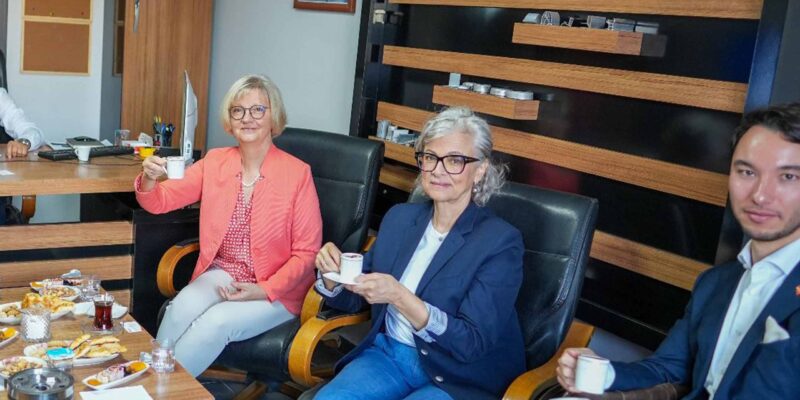
“FOSTER’s Legacy & Beyond” Event took place with the participation of 186 representatives from the relevant institutions including the private sector, civil society organisations working in the field of employment and social integration, and all stakeholders who contributed to the project.

The event commenced with opening speeches delivered by Mr. Melih Çadırcı, Deputy Country Director of KfW Development Bank, Ms. Esther Bouma, Human and Social Development Team Leader at the Delegation of the European Union to Türkiye, and Mr. Melih Gökgöz, KOSGEB Vice President.

Furthermore, a panel session was held featuring local stakeholders, project beneficiary SME and people employed under the project, allowing participants to hear the project’s impact on the ground firsthand. Following the session, the event concluded with a plaque ceremony.

We extend our gratitude to all implementing parties, stakeholders, and all participants who contributed to the successful completion of the FOSTER I Project.


Sanayi Logo

Kosgeb Logo

KFW Logo


Ikbal Group Stands Out with Environmentally Friendly Business Practices!

Thanks to the FOSTER Project’s Employment Committed SME Support Programme, Kilis-based Ikbal Group employed four people, including two Turkish citizens and two foreigners under temporary protection. The company is also distinguished by its environmentally friendly business practices, fulfilling its social responsibilities while developing sustainable business strategies. Taking a proactive approach to global issues such as climate change and resource scarcity, Ikbal Group demonstrates its commitment to environmental and social responsibility. The FOSTER team conducted an interview to learn more about how Ikbal Group manages these processes.

FOSTER Team (F): Mr. İbrahim Güvenç, your company has environmental and occupational safety systems. What are these systems, how do you implement them, and what are the benefits in your opinion?

Mr. İbrahim Güvenç (İ.G): Occupational safety is one of the most crucial issues for employees worldwide and across different sectors. Through trainings provided to employees and safety measures implemented within the factory, we have created a less risky working environment. Our environmentally friendly system aims to control all types of waste and emissions in our factory, thereby protecting nature while strengthening the sustainable economy.

F: You’ve applied for the environmental permit and gone through processes such as emission measurements. What kind of improvements did you make in your facility during these processes?

İ.G: With the environmental permit we obtained on April 25, 2024, we have made significant progress towards the implementation of Environmental Law No. 2872., especially in areas like emission control, waste management, and water pollution prevention. Alongside sustainability, we aim to minimize environmental risks.

F: We see that your systems are automated. Did the transition to automation provide benefits in terms of energy, raw materials, intermediates, occupational safety, and environmental aspects? Can you explain this?

İ.G: Having automated systems means that machines do not run when there is no production. Through the automated systems, water, electricity and energy waste has been prevented.

F: Do you have a system for monitoring energy efficiency at your facility? What measures are you taking?

İ.G: We monitor the values of electricity, natural gas, and water consumption every month under a tracking document, and we take necessary actions each month.

F: You operate with a performance-based system in your facility. How do you implement this, and what benefits does it provide you?

İ.G: We value personal and corporate development. By rewarding employees, we want to become a productive institution where original ideas are generated, aiming for less energy consumption and higher efficiency through strategic methods.

F: Are there any other practices you would like to add, or any advice for other SMEs?

İ.G: The most important recommendation we have for SMEs is to prioritize the occupational health and safety of all employees, minimize environmental risks, and avoid energy waste. Our mission is to move our organizations and our country to better positions through entrepreneurial employees.

F: Thank you for your excellent efforts.


Sanayi Logo

Kosgeb Logo

KFW Logo


Achieving Success with the Power of Women’s Employment in Technology: Hafzullah Yıldırım’s Story

Due to his interest in technology, Mr. Hafzullah Yıldırım stepped into the technology sector after completing his Civil Engineering education and established his own company in 2017 with the support of KOSGEB. His company, which offers result-oriented web design, custom web-based software, SEO (search engine optimization), e-commerce, and social media management solutions to companies of all sizes worldwide, has grown rapidly by developing mobile applications and web-based projects. The company has undertaken significant projects, including those for Boğaziçi University and Hagia Sophia.

Learning about the FOSTER Project’s Employment Committed SME Support Programme through KOSGEB, Mr. Hafzullah Yıldırım applied for financial support, which helped him employ staff to expand into Arabic-speaking countries by offering localization and translation services.

Within the scope of the FOSTER Project, the company not only retained the employment of two Turkish citizens but also hired two foreigners under temporary protection. Therefore, the company experienced significant growth, especially in the Arabic-speaking market. Currently, the company operates with 11 employees, five of whom are women. By prioritizing women’s employment, Mr. Hafzullah Yıldırım supports the greater inclusion of women in the technology sector.

Mr. Hafzullah Yıldırım states that one of the key factors in the company’s success is the employment of women in software and technology, allowing them to play an active role in managing processes. He emphasizes that women’s employment has made significant contributions to the company’s growth and the successful completion of projects.

Creating Her Own Opportunity: Esra Çiçek’s Success Story Driven by Women’s Employment

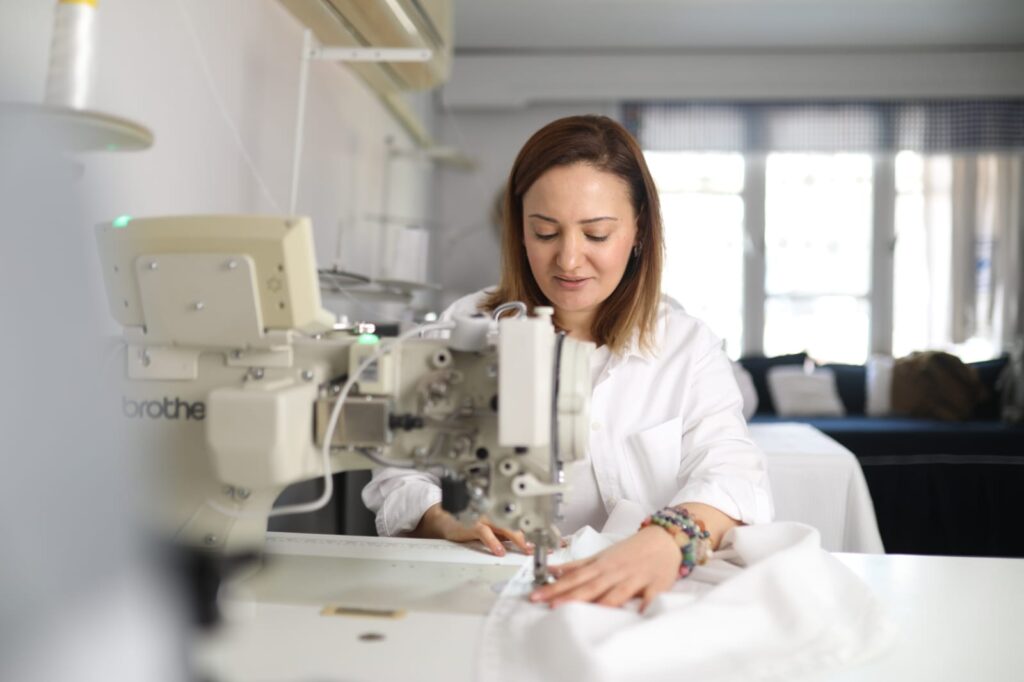
Ms. Esra Çiçek’s success story begins with her brave decision to pursue her dream during the pandemic. After working in human resources, she decided to leave her job and turn her long-held aspiration of starting a home textile production business into reality. In 2021, she established her own company in Adana. The company produces a variety of home textile products, including bedspreads, duvet covers, pillowcases, placemats, tablecloths, and decorative home textiles.

Through KOSGEB, she learned about the FOSTER Project’s Employment Committed SME Support Programme. She applied to the project and received financial support, which allowed her to retain one employment position while also hiring another Turkish woman and two foreigner women under temporary protection. Initially, she was the sole worker in her business, but with the financial support from the project, she expanded her team to four, all of whom are women. This support increased the workforce, which in turn boosted the company’s production capacity and revenue.

For Ms. Esra Çiçek’s company, the most significant contribution of the FOSTER Project was expanding production capacity through increased employment, helping her to achieve sales targets faster.

Ms. Esra Çiçek took a similar approach after the earthquake that affected Adana. While home textile sales initially came to a standstill, the demand for her products increased as people in the region began rebuilding their homes. She continued production, striving to meet the needs of the local community.

Looking ahead, Ms. Esra Çiçek aims to grow her e-commerce presence by expanding online sales channels and plans to open a small boutique store for retail sales. She continues her journey as a role model, demonstrating how women can strengthen their place in the business world.

Ermed Medikal: Growing Through Women’s Employment and Innovative Production

Ermed Medikal is a rapidly growing company in the medical sector, founded in 2009 by Mr. Eray Karataş and his brother Mr. Emre Karataş. Initially focused solely on the trade of medical supplies, the company underwent a significant transformation in 2020 by venturing into production. Today, they trade and manufacture a wide range of medical products, including masks, protective overalls, and bandages, operating a modern 3,600 m² production facility in Kartepe, Kocaeli. This facility is equipped with clean rooms and testing laboratories, ensuring production in line with international standards.

One of the key elements behind Ermed Medikal’s success is their emphasis on supporting female employees. Through the FOSTER Project’s Employment Committed SME Support Programme, the company hired two Turkish citizens and two foreigners under temporary protection, increasing their total workforce to 127. The support amount received was used exclusively for employment, and currently, 50% of the workforce consists of women. The financial support provided by the FOSTER Project has helped retain qualified personnel, particularly women in the production units, who play a key role in the company’s growth.

The personnel employed through the project have taken on leadership roles in production processes, significantly contributing to the manufacture of quality products. Even after the project’s completion, Ermed Medikal has committed to retain employment, ensuring they maintained their skilled workforce. The company’s focus on female participation in the workforce not only provides social benefits but also enhances the efficiency of business processes. Women employees hold strategic roles not just in production but also within the company’s corporate structure.

With the financial support through the project, Ermed Medikal continues to grow and is steadily moving towards international branding. The company aims to establish itself as a reputable name not only domestically but also in foreign markets with its high-quality products.

Beydağ Tekstil: A Success Story of Empowering Women and Embracing Sustainability

Founded in 1996, Beydağ Tekstil made a strong entry into the textile industry by producing open-end yarn from recycled cotton and polyester fibers. In 2008, the company expanded its operations by adding dyeing, bleaching, and washing processes with a daily production capacity of 20 tons. This growth not only enhanced the company’s competitiveness but also allowed it to take innovative steps within the sector.

One of the key features that distinguishes Beydağ Tekstil is its commitment to social responsibility, particularly its emphasis on women’s employment. Through the FOSTER Project’s Employment Committed SME Support Programme, the company added four new employees to its workforce, including two Turkish women and two foreigners under temporary protection.

Another strength of Beydağ Tekstil lies in its commitment to sustainability. The company aims to produce in an environmentally friendly manner by utilizing renewable energy sources (solar energy projects) and conserving water. Additionally, by using recyclable materials in their products, they take significant steps towards environmental protection, setting an example for other companies in the sector.

The financial support provided through the FOSTER Project helped the company retain qualified employees and achieve both its social and environmental sustainability goals. Emrah Tuğrul, the financial advisor at Beydağ Tekstil, noted that this support was particularly beneficial in alleviating the financial burden on the company after the COVID-19 pandemic and the earthquakes in the region.

Beydağ Tekstil, with 225 employees, continues its mission of creating equal opportunities for women and foreigner under temporary protection. At the same time, their environmentally friendly production practices make it a leader in responsible business practices within the industry. The company aims to generate a more positive impact in the future in terms of both economic growth and environmental responsibility.