A Former Journeyman Who Now Produces 15,000 Machines Annually

Mustafa Badıllı (54) shares his entrepreneurial journey as the first agricultural machinery producer in Şanlıurfa. He has a degree in elementary education and founded his own business after identifying a need in the market and spending years learning the trade as an apprentice and journeyman. Mustafa Badıllı, managing a company that produces 15 thousand agricultural spraying machines a year, says that they enlarged their machine park and purchased raw materials with the loan they used via the FOSTER Project.

He says that creating Badıllı Makine ve Tarım was primarily driven by the desire to create jobs and support the national economy through production and exports. However, Badıllı claims that since they started the business, finding qualified employees has been their biggest challenge. During the Covid 19 pandemic, they also had trouble supplying raw materials because of the high cost, but as the demand for food increased, their operations sped up and they began to operate at full capacity.

The effects of the earthquake according to Badıllı, are as follows: “We had dealers in the earthquake region therefore, our business volume has decreased. Our production facilities kept operating without any damage but we lost one of our employees to the earthquake. As a result of our lack of motivation during daily operations, we fell behind in production.” In order to quickly reverse the negative effects of the earthquake, he draws attention to the financial requirements of the local businesses.

Badıllı’s goal is to “increase production capacity, establish additional production facilities, diversify export countries and increase employment”. Badıllı emphasises, “The subsidy has contributed to the purchase of raw materials and machinery,” claiming that the FOSTER Project’s long maturity and low interest rate/profit share attracted them. We anticipate that these initiatives will continue to support the growth of SMEs engaged in production and export.

Güven Elektrik Wants to Expand with New Investments

Güven Elektrik, which is an Ankara based firm producing high voltage electrical materials, intends to expand through new investments. Zeki Tavas, company owner, explains that after moving their operations from Şanlıurfa to Ankara, they expanded internationally.

Zeki Tavas (50) is a second generation entrepreneur who describes himself as a person with high entrepreneurial and competitive spirit. Tavas relocated his business from Şanlıurfa to Ankara in an effort to establish himself as a leading figure in the industry. He describes their growth in the sector as follow: “Our trade volume has significantly increased since we arrived in Ankara. This enabled us to access international markets. We seized the opportunity to take part in significant projects in Türkiye and abroad. We are very happy with what we have achieved so far.”Tavas states that they produce high voltage mobile transformers, high voltage power lines and transformer insulators, and they are working with major investors and contractors in Türkiye. They are also selling to markets in Africa and the Middle East.

Güven Elektrik has the following future goals: “We are planning to make a new investment for high voltage power lines and insulators. With regard to the advent of electric cars, one of our future targets is to produce solar panels and industrial batteries.”

Tavas acknowledges that the loan provided by the Employment Committed SME Finance Support Programme within the FOSTER Project has been very helpful for their business since it offers 50% subsidized loans. Tavas explains the benefits of the Project loan as follows: “The loan helped us increase our employment and business development capacity. It supported our cash flow by decreasing our production cost.”  

Tepe Baca is Growing through Franchise

İsmail Salih Tatlıoğlu, a 34-year-old entrepreneur, founded Tepe Baca ve Havalandırma Sistemleri in 2019. It stands out in the sector by producing stainless chimneys for the construction industry. İsmail Salih Tatlıoğlu previously worked for another construction firm, and now he intends to expand his business by promoting his brand both in Türkiye and abroad.

İsmail Salih Tatlıoğlu emphasises the significance of being the only company in Ankara with a product range of stainless steel chimneys, waste separation systems, and ventilation ducts produced. He initially hopes to establish dealerships in Turkey and abroad.

Tepe Baca ve Havalandırma Sistemleri has currently 19 employees and is exporting waste separation systems to Iraq. Tatlıoğlu states that the interest rate and profit share they received through the FOSTER Project helped them become more competitive in the industry. The low interest rate and profit share allowed for the purchase of raw materials by cashing in postdated checks, according to his description of the project’s benefits. “It has increased market competition, which has accelerated our business.” He continues.  

FOSTER Project Relieves Temizsoy’s Cash Flow

Having used a loan for the first time with the FOSTER Project, Temizsoy Mobilya had improved its cash flow thanks to the interest rate/profit share subsidy. Oktay Temizsoy, one of the company partners, mentions they purchased raw materials with the loan to expand their exporting activities.

When it was established in 1986, the company produced only furniture frames. Today, it continues to operate by producing flooring with 50 employees and 20 different product lines in the field of furniture and armchairs. Temizsoy explains that while the business was growing, it was challenging to find qualified employees. However, they were able to overcome these challenges by using social media to reach more people and the opportunities provided by the FOSTER Project for long-term employment. Temizsoy notes that there were delays in container shipments and that their business was impacted by the Covid 19 pandemic-related measures, but he adds that as soon as those measures were lifted, their business and orders increased. Temizsoy Mobilya has been exporting to almost all European countries as well asIraq, Saudi Arabia, Palestine, Uzbekistan, Kazakhstan, Canada and Ghana and aims to increase the exports of the company. Due to a tendency towards automation, they also want to expand the machinery-equipment park while decreasing the human workload.

Temizsoy underlines that the FOSTER Project Employment Committed SME Finance Support Programme relieved their cash flow and the most advantageous aspect of the loan is the long-term maturity and low interest rate.

Women Strengthens the Furniture Industry

Esma İşel (53) praises the women touch in the furniture industry as an objective and aesthetic point of view. Having worked as a calibration specialist, control engineer and mechanical engineer for many years in different companies, İşel has now started to work at T En Enerji; a family-run company that produces kitchen tables, chairs and coffee tables. İşel, who became a partner in the family business with the support of her brother, says that they purchased raw materials with the loan provided within the scope of the FOSTER Project.

After graduating from Mechanical Engineering Department at Erciyes University in 1991, she got her master’s degree on solar energy in 1997. She is justifiably proud of being the first woman in Turkey to publish a calibration thesis. İşel stands out in the male-dominated furniture sector thanks to her training in quality control and personal development. Undertaking a responsible position in human resources, finance and corporate relations, İşel notes that women are shy in the sector; as a result, she encourages them to complete job-related trainings they desire and to follow the relevant support offered through various programmes.

T En Energy faces difficulties in purchasing raw materials therefore, they used the loan to buy raw materials such as pipe profiles. She emphasizes that low interest rate/profit share and long-term maturity are the loan’s most significant benefits.

İşel provides in-depth details about the issues they encountered as a result of the rise in container prices during the Covid 19 pandemic and also mentions that the transportation processes took a very long time. Additionally, she mentions the effects of the earthquake as follows: “After the Kahramanmaraş earthquakes, stores suffered field damages, and our current orders were cancelled. The supply of raw materials and pipe profiles was affected the most by the earthquake, especially due to damage to a particular factory”.She registered the Bystol brand of her company with the European Union, and her next objective is to “own the Turquality brand.”

The FOSTER Project Advances the Entrepreneurship Journey that Began with Selling His House

After working for a furniture company, Alper Karaman, 46, who graduated from the business administration programme at Mustafa Kemal University, began his entrepreneurial journey in 2019. Karaman describes how the support he received from the FOSTER Project helped his business grow. Alper Karaman was born in Kayseri which is the hub of furniture industry in Türkiye.. In the course of his entrepreneurial journey-which he started by selling his home-Karaman now produces furniture like bunk beds, dressing room cabinets, foldable portable tables, refrigerators, large metal office supplies, and wheeled tools.

Karaman, who is also the Türkiye distributor of a foreign lock manufacturer, decided to follow his entrepreneurial dream after gaining experience for 13 years in various fields from production to planning. With the help he received from the FOSTER Project, he bought a welding machine and opened his own static paint shop in the machine park. The low interest rate, profit-sharing, and simple repayment terms of the loan, according to Karaman, allowed them to start mass production instead of pre-contracting dyeing and cut costs.

Duayen Yapı Grows with R&D Activities

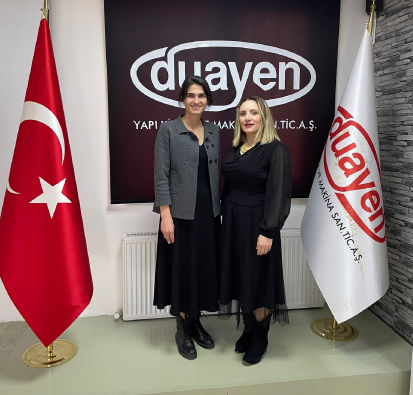
Engaging in exporting activities and planning to open a new factory in Dubai, Duayen Yapı channeled its interest rate/profit share subsidy to R&D activities. Şengül Şahan, Domestic Sales Manager of Duayen Yapı, talks about their operations in production of insulation materials, paints and glues and adds “Our main driving force is to become a world-class and eco-friendly company that will represent our country in the top-tier in the construction, defense and industrial fields.”

Duayen Yapı has been established in 2015 and has 60 employees, 35 of whom are women. Şengül Şahan states that they produce various paints with polyurethane and epoxy-based insulation materials, but the fire paints that are produced in R&D centers are one of the most unique products, as they prevent fire’s spread up to 120 minutes. She emphasizes that polyurea product groups, which garner a lot of interest, particularly from the defense industry and the military, serve as a shield against bombs, weapons and missiles and have a significant impact in the industry. Duayen Yapı has two factories in Tuzla Free Zone and production lines in Dudullu where they export their products to 70 countries. Şahan emphasizes how crucial it is for them to collaborate with 17 Chemical Engineers in the R&D centres and explains how they used the loan from the FOSTER Project Employment Committed SME Finance Support Programme to increase their R&D efforts, boost the company’s technical capacity, and simplify domestic and international payments.

Increasing Family-Owned Business Through Exports

Ümit Özgül learned metalworking with his father at a very young age and expanded his business following his graduation of mechanical engineering. He currently works with liquid cargo storage companies in Turkey’s busiest ports, and he says that they used the loan provided by the FOSTER Project, to pay for materials, relieving them of the financial burden.

Explaining that they operate in sheet metal forming, laser cutting, bending, welding, painting, assembly, maintenance, and modification areas; Özgül adds they currently appeal to larger masses by improving the small-scale works with the new bending and laser machines purchased. Ümit Özgül had 15 employees in the 2010s; today, they have more than 80; however, they are having difficulty finding qualified workers in the industry.

Özgül states that although the earthquake had no effect on their operations, their business volume has decreased as a result of the COVID-19 pandemic.  According to him, the loan’s appeal was due to its “long-term maturity, monthly installments, and low interest rate/profit share opportunity” within the Employment Committed SME Finance Support Programme. Since they are earning money through progress billing, the loan relieves them of pre-financing obligations, and they intend to grow gradually but steadily. They also plan to complete projects like the liquid cargo tank and pipelines in two major ports without using intermediaries.

The Path from Apprenticeship to Entrepreneurship

Young businessman Aygün Keskin, 29, is a partner in the winding company where he began his career as an apprentice. By using the loan they received through the FOSTER Project’s Employment Committed SME Finance Support Programme to buy raw materials, he hopes to increase their output. At a young age, Aygün Keskin began working as an apprentice at Gebze Aslan Bobinaj. He joined the company as a partner when his boss decided to grow the business. Aygün explains that they are operating in the winding, maintenance and renewal of electric motors that provide the rotation of the working systems of the casting, automotive and iron industries. The biggest problem, according to him, is a lack of qualified personnel. Noting that they are trying to overcome the problem through longer working hours, Aygün said “While factories are working in double shifts in Kocaeli, we work in one shift due to the small number of staff. We established our company on an area of ​​60 m2, then expanded it to 500 m2 and now our dream is to install our factory up 1000 m2 area.” They were able to purchase raw materials through the financial support they received as part of the FOSTER Project, and Aygün emphasises the convenient loan repayment terms in contrast to the difficulties they faced as a result of the fluctuating price of copper.

Adams Diş is Building its Future with the FOSTER Project’s Loan

Tevfik Ali Demir, 43, launched his second business, Adams Diş, one of the FOSTER Project’s beneficiary SMEs in Gaziantep. Before starting his new business to produce dental prosthetics five years ago, Demir worked in the auto repair industry. Demir has an aspiration to continue his business whereby training those who want to learn the profession. Being fascinated by the dental prosthesis sector since his childhood, Demir participated in a training programme in this subject after starting his own vehicle maintenance company. Meanwhile, he worked as an apprentice in a dental clinic. He is a graduate of business management, and this enables him to use the knowledge he has learned in the classroom to his business. Demir, who currently owns a business that employs 24 people and produces 150 prostheses per day, wants to create a company that maintains its prosthesis manufacturing operations while also serving as a training facility to help close the training gap in this industry. When it comes to both capacity and technology, Adams Diş occupies a solid position in the industry. They have 60% of their processes digitalized thanks to their 3D printers. Despite the Covid 19 pandemic’s capacity drop to 10-15% and the earthquake’s disruption of the business for a week, they were able to bounce back. Demir provides the following justification for how the FOSTER Project subsidy will help the business develop in the future: “We have been able to buy our raw material stock for the next two years. This has helped us to lower our costs for the upcoming period while also boosting our profits. Additionally, because we paid cash, the supplier gave us a sizable discount.